
















Key Takeaways
- Toronto’s highest-risk intersections are concentrated along major corridors with heavy traffic, pedestrians, and transit activity.
- Yonge & Finch, Eglinton & Don Mills, and Lakeshore & Parkside are consistently highlighted due to collision patterns and road complexity.
- Most intersection crashes stem from driver behaviour: distraction, speeding, failure to yield, and aggressive turning movements.
- Pedestrians and cyclists are disproportionately affected, especially at wide arterial roads and multi-lane intersections.
- Risk is not static: rush hours, nighttime driving, winter weather, and low visibility significantly increase collision severity.
- Different Toronto districts show different risk profiles depending on road design, traffic volume, and commuter patterns.
- Despite improvements under Vision Zero, intersections remain the most common locations for serious collisions in the city.
- Male and younger drivers are statistically overrepresented in serious crashes, while older drivers face higher injury severity.
Overview of Traffic Safety
Toronto is one of the busiest cities in Canada, with millions of drivers, cyclists, pedestrians, TTC vehicles, delivery trucks, and rideshare drivers sharing the roads every single day. As the population of the Greater Toronto Area continues to grow, traffic congestion has become a major concern across the city. Unfortunately, with more vehicles on the road comes a higher risk of serious motor vehicle accidents at some of Toronto’s most dangerous intersections. From downtown Toronto to North York, Scarborough, Etobicoke, and the Gardiner Expressway corridor, collisions continue to happen at an alarming rate. Many of these crashes lead to severe injuries, lost wages, chronic pain, emotional trauma, and complicated insurance claims for accident victims.
Traffic safety in Toronto has become an increasingly important issue for drivers, pedestrians, cyclists, and city officials alike. Dangerous intersections often involve a combination of heavy traffic volume, aggressive driving, distracted driving, speeding, poor visibility, unsafe left turns, and pedestrian congestion. Intersections near Highway 401, the Don Valley Parkway, Yonge Street, Eglinton Avenue, Finch Avenue, and Lake Shore Boulevard consistently see high numbers of collisions every year. Understanding where accidents happen most frequently can help drivers make safer decisions and may even help reduce the likelihood of a serious car accident. For anyone injured in a collision in Toronto or the GTA, speaking with an experienced Toronto personal injury lawyer can be critical when pursuing compensation for medical expenses, lost income, rehabilitation costs, and pain and suffering.
What Are the 3 Most Dangerous Intersections in Toronto
Determining the most dangerous intersections in Toronto is not as simple as looking at a single crash report. Transportation experts typically examine a combination of collision frequency, pedestrian injuries, cyclist injuries, traffic volume, serious injuries, and fatalities. According to Toronto’s Vision Zero Road Safety Plan, intersections and major arterial roads continue to be the locations where the highest concentration of serious and fatal collisions occur. Vulnerable road users, including pedestrians and cyclists, remain disproportionately represented in severe crashes. The City of Toronto’s traffic safety data consistently shows that pedestrians account for a significant percentage of traffic fatalities despite making up only a portion of total road users.
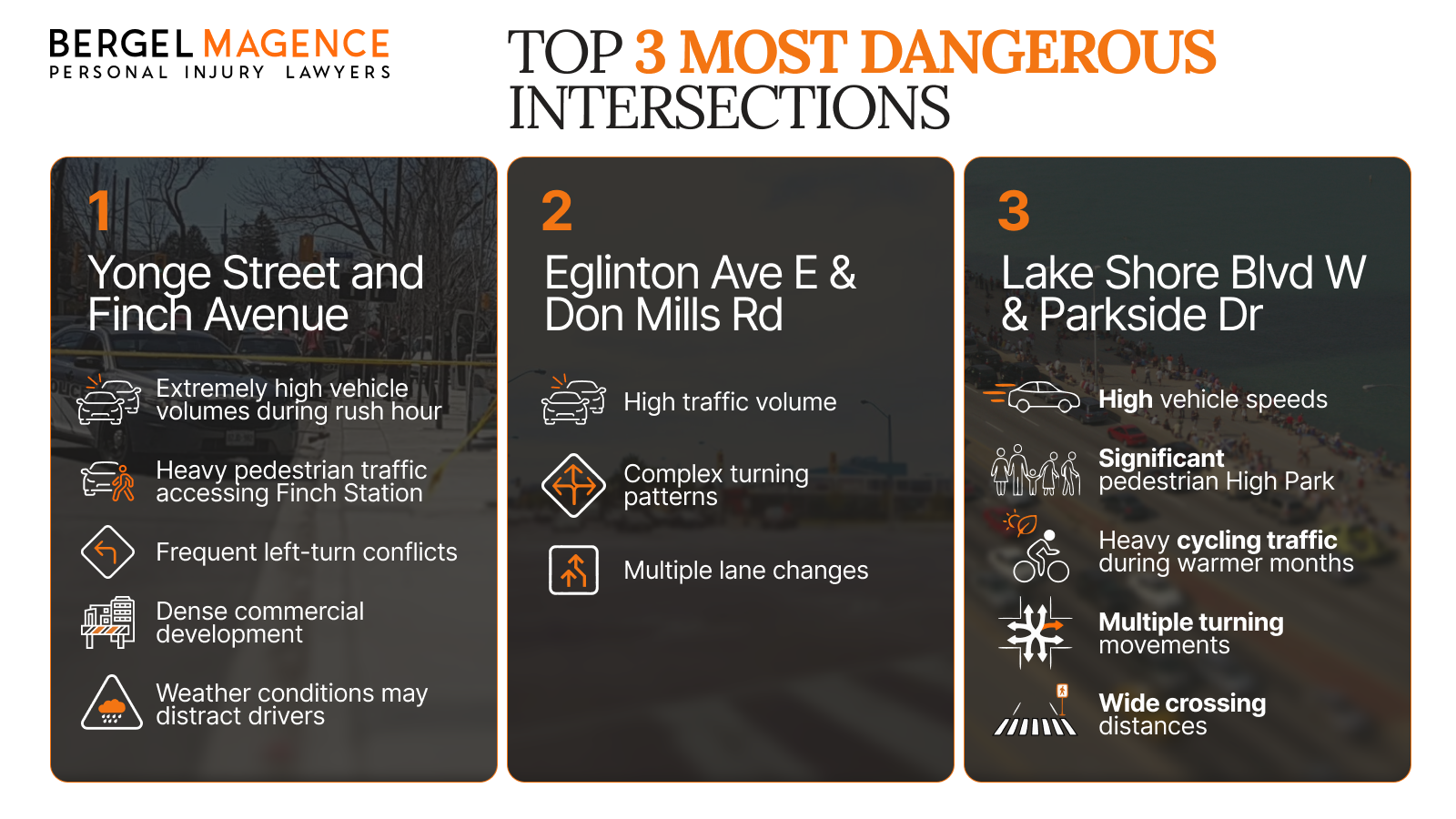
Yonge Street and Finch Avenue
The intersection of Yonge Street and Finch Avenue in North York has long been recognized as one of Toronto’s busiest and most collision-prone intersections. Every day, tens of thousands of vehicles, TTC buses, pedestrians, cyclists, and subway commuters pass through this area. The combination of heavy turning movements, multiple transit stops, pedestrian crossings, and significant traffic congestion creates numerous opportunities for collisions.
Several factors contribute to the risks at Yonge and Finch:
- Extremely high vehicle volumes during rush hour
- Heavy pedestrian traffic accessing Finch Station
- Frequent left-turn conflicts
- TTC buses entering and exiting the terminal
- Driver distraction caused by dense commercial development
- Weather conditions may distract drivers, leading to increased opportunities for collisions
Pedestrians face particular risks at this intersection because of the sheer number of people crossing in all directions throughout the day. Drivers often focus on navigating congestion and turning traffic, increasing the likelihood of failing to yield to pedestrians. Cyclists travelling along Yonge Street must also contend with vehicles making sudden turns or lane changes, and drivers trying to make sudden turns to on late yellow lights. This area remains one of the busiest transportation hubs in the City of Toronto and consistently appears on lists of high-collision locations.
Eglinton Avenue East and Don Mills Road
Eglinton Avenue East and Don Mills Road is another intersection that has historically generated significant safety concerns. Located near major shopping centres, office towers, residential developments, and transit connections, the intersection experiences substantial traffic volumes throughout the day.
The dangers here stem from several overlapping factors, such as multiple turning lanes, high vehicle speeds approaching the intersection, heavy bus traffic, large numbers of pedestrians crossing a wide roadway, and significant commuter traffic connecting to the Don Valley Parkway.
Research consistently shows that wider intersections increase the exposure time for pedestrians crossing the street. At locations such as Don Mills and Eglinton, pedestrians often need to navigate multiple lanes of moving traffic while drivers attempt complex turning movements. Cyclists can be particularly vulnerable when vehicles fail to check blind spots during right or left turns.
This corridor also experiences significant traffic during peak commuting periods because it serves as a major connection between North York, Scarborough, East York, and downtown Toronto. The volume of road users dramatically increases the likelihood of collisions involving cars, trucks, pedestrians, and bicycles.
Lake Shore Boulevard West and Parkside Drive
Lake Shore Boulevard West and Parkside Drive has gained attention in recent years because of several serious and fatal collisions involving pedestrians and cyclists. The intersection sits near High Park, waterfront destinations, cycling routes, residential neighbourhoods, and major commuter corridors.
Several characteristics make this area particularly dangerous:
- High vehicle speeds compared to downtown Toronto streets
- Significant pedestrian activity from High Park visitors
- Heavy cycling traffic during warmer months
- Multiple turning movements
- Wide crossing distances
Speed remains one of the most significant factors in collision severity. Transportation safety experts note that the likelihood of a pedestrian suffering life-threatening injuries increases dramatically as vehicle speeds rise. Toronto’s Vision Zero program specifically identifies speed management as a critical strategy for reducing fatalities and serious injuries.
Cyclists travelling between downtown Toronto, Etobicoke, and the Martin Goodman Trail frequently pass through this area. During peak cycling season, the interaction between fast-moving vehicles and vulnerable road users creates elevated risks. Pedestrians crossing between High Park and the waterfront also face challenges due to roadway width and traffic volumes.
Why These Intersections Are So Dangerous
While these intersections are located in different parts of Toronto, they share several common characteristics. They all experience exceptionally high traffic volumes, significant pedestrian activity, complex turning movements, and periods of heavy congestion. Studies of traffic collisions consistently show that intersections are among the most common locations for crashes involving pedestrians and cyclists. Toronto’s transportation datasets contain traffic counts representing nearly 500 million motor vehicle observations, 56 million pedestrian observations, and more than 4.5 million bicycle observations, highlighting the enormous number of daily interactions occurring across the city’s road network.
For drivers, the greatest risks often involve distracted driving, speeding, aggressive lane changes, and failure to yield. For pedestrians, risks typically arise when crossing wide arterial roads or navigating intersections with multiple turning lanes. Cyclists face dangers from right-hook and left-hook collisions, dooring incidents, and vehicles failing to share the road appropriately. Understanding where these risks are highest can help all road users make safer decisions and reduce the likelihood of a serious motor vehicle accident in Toronto.
It is important to note that we are focusing only on intersections in the city of Toronto. There are many dangerous intersections outside of the city, in other areas of the GTA, like Highway 7 and Weston Rd in Vaughan, Hurontario St and Dundas St in Missisauga, and Brock Rd and Taunton Rd in Pickering.
Historical Trends in Toronto Traffic Accidents
Toronto has experienced significant changes in traffic safety over the past decade. As the city’s population has grown and more vehicles, cyclists, and pedestrians use the roads, traffic accidents have remained a major concern. In response to rising collision rates and pedestrian accidents, the City of Toronto launched its Vision Zero Road Safety Plan in 2016. The initiative introduced numerous safety measures, including improved traffic signals, lower speed limits, redesigned intersections, enhanced crosswalks, and expanded cycling infrastructure.
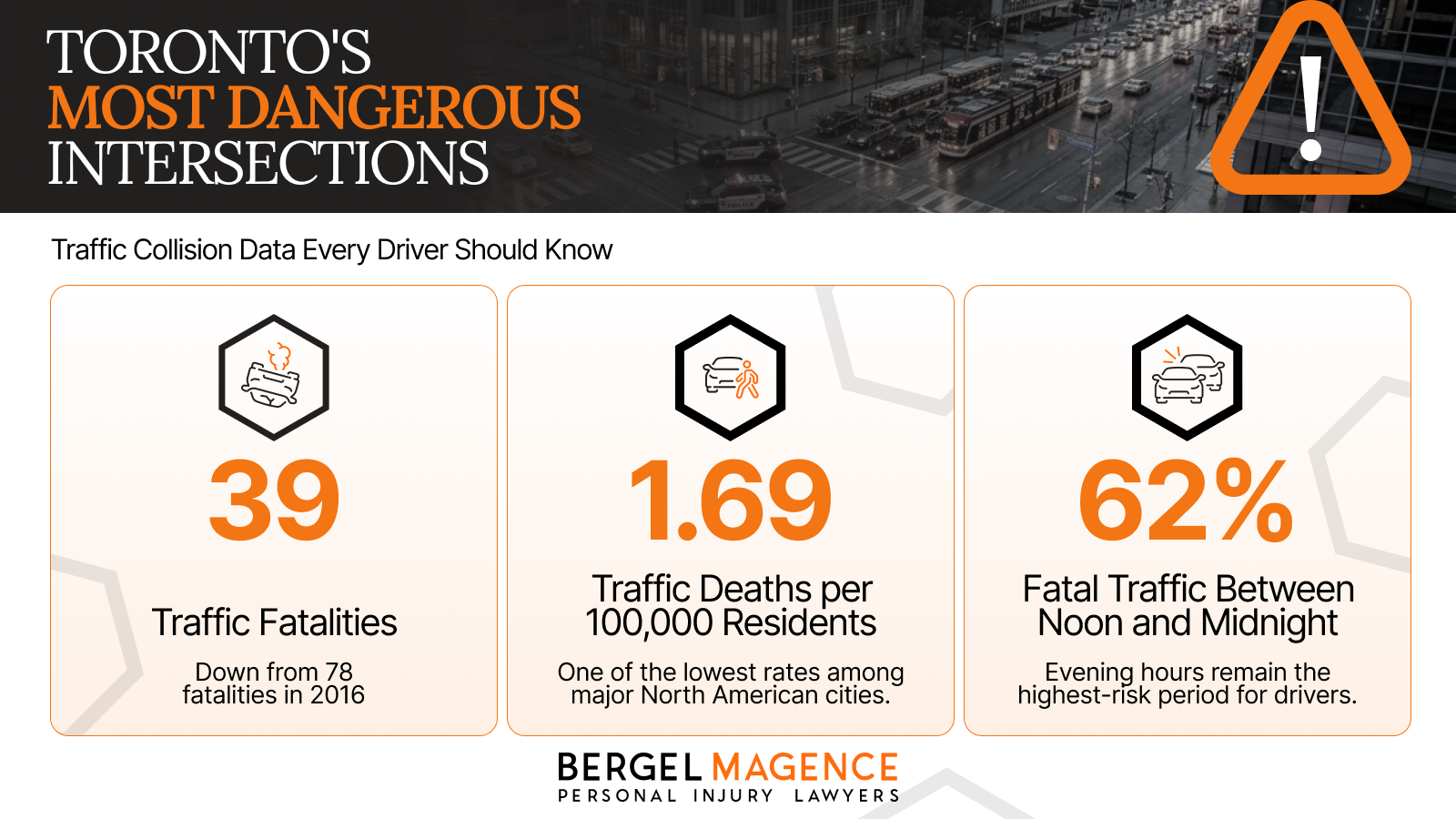
While overall collision numbers fluctuate from year to year, Toronto has generally seen a decline in traffic-related fatalities since Vision Zero was introduced. The city recorded 78 traffic fatalities in 2016 compared to just 39 fatalities in 2025. This progress has occurred despite increasing traffic volumes throughout Toronto, North York, Scarborough, Etobicoke, and other parts of the GTA. Many of the improvements have focused on reducing collisions at high risk intersections where serious crashes occur most frequently.
Pedestrian accidents continue to be a significant traffic safety challenge across Toronto. Many of the city’s most serious collisions occur at high-risk intersections and along major arterial roads such as Yonge Street, Eglinton Avenue, Finch Avenue, Sheppard Avenue, and Lake Shore Boulevard. Factors such as speeding, distracted driving, failure to obey traffic signals, and unsafe turning movements continue to contribute to pedestrian and cyclist injuries throughout the city.
For drivers, the leading causes of motor vehicle accidents have remained relatively consistent over time. Speeding, distracted driving, impaired driving, aggressive driving, and red-light violations continue to cause thousands of collisions every year. Although Toronto’s safety measures have helped improve road safety, historical collision data shows that dangerous intersections and busy traffic corridors remain some of the highest-risk locations for drivers, pedestrians, and cyclists across the city
Common Causes of Accidents at Toronto Intersections
Toronto’s dangerous intersections are responsible for a large percentage of the city’s traffic collisions. Intersections pose unique risks because they bring together vehicles, pedestrians, cyclists, transit users, e-bikes, and scooters in a confined space. Heavy traffic volumes, multiple turning movements, and changing traffic signals create situations where even a brief lapse in attention can result in a serious accident.
Distracted driving remains one of the leading causes of intersection crashes throughout Toronto. Drivers who are texting, using navigation systems, eating, or otherwise not focused on the road may miss red lights, fail to yield, or overlook pedestrians and cyclists. Speeding and aggressive driving also contribute to many collisions, particularly on major roads such as Finch Ave, Steeles Ave, Bathurst St, Dufferin St, Bloor St, and Lakeshore Blvd where traffic volumes are consistently high.
Cyclists face additional risks at busy intersections, even where bike lanes are present. Many collisions occur when drivers make left or right turns without properly checking for cyclists travelling through the intersection. These turning conflicts are especially common along major Toronto corridors where vehicles, bicycles, and pedestrians are all competing for space.
The growing popularity of e-bikes and electric scooters has created new safety concerns across the city. While many riders follow the rules, others travel at high speeds on sidewalks or along the sides of roads where drivers and pedestrians may not expect them. This can increase the risk of collisions, particularly near intersections where visibility is limited and traffic patterns are already complex.
Weather conditions, poor visibility, and failure to yield the right-of-way further contribute to collisions at Toronto’s most dangerous intersections. Whether travelling along Finch Ave, Steeles Ave, Bathurst St, Dufferin St, Bloor St, or Lakeshore Blvd, drivers, cyclists, and pedestrians should remain alert and exercise caution. Understanding these common causes of accidents is one of the most effective ways to reduce injuries and improve road safety throughout Toronto.
Regional Differences: High-Risk Areas by District
Not all dangerous intersections in Toronto share the same characteristics. The factors that contribute to collisions in downtown Toronto are often very different from those found in North York, Scarborough, Etobicoke, or East York. Traffic volumes, road design, pedestrian activity, transit usage, and vehicle speeds all vary significantly across the city. Understanding these regional differences helps explain why certain locations consistently rank among the most dangerous intersections in Toronto.
In Downtown Toronto, many of the most dangerous intersections are found along corridors such as Yonge Street, University Avenue, Queen Street, King Street, and Dundas Street. Intersections like Yonge and Dundas are heavily influenced by pedestrian congestion rather than high vehicle speeds. Thousands of pedestrians cross these intersections daily while drivers, cyclists, delivery vehicles, rideshare operators, and TTC vehicles compete for limited road space. The combination of dense traffic, frequent turning movements, and constant pedestrian activity makes downtown home to some of the most dangerous intersections in Toronto for pedestrians and cyclists.
North York experiences a different set of challenges. Major intersections such as Yonge Street and Finch Avenue, Yonge Street and Sheppard Avenue, and Dufferin Street and Finch Avenue handle enormous commuter traffic volumes every day. These intersections are often larger than those found downtown, with multiple turning lanes, bus terminals, and connections to Highway 401. Congestion, aggressive lane changes, and distracted driving are common contributors to collisions in this part of Toronto. The sheer number of vehicles travelling through these intersections creates a higher risk of rear-end crashes, side-impact collisions, and pedestrian injuries.
In Scarborough, high-risk intersections are frequently located along wide arterial roads such as Kingston Road, Lawrence Avenue East, Markham Road, Midland Avenue, and Eglinton Avenue East. Intersections such as Markham Road and Lawrence Avenue East or Kingston Road and Eglinton Avenue East often involve higher vehicle speeds than those seen in the downtown core. Long crossing distances, large commercial developments, and heavy commuter traffic contribute to a greater risk of serious collisions. Pedestrians crossing these wide roadways may be exposed to traffic for longer periods, increasing the likelihood of severe injuries when accidents occur.
Etobicoke’s most dangerous intersections are often concentrated near major transportation corridors including Highway 427, The Queensway, Kipling Avenue, Islington Avenue, and Lakeshore Boulevard West. Intersections such as Kipling Avenue and Dundas Street West or The Queensway and Islington Avenue experience a mix of local traffic, commercial vehicles, and commuters travelling to and from Toronto’s western suburbs. Higher travel speeds and significant turning movements frequently contribute to serious motor vehicle accidents. Areas near Highway 427 interchanges can be particularly hazardous because of merging traffic and driver decision-making under heavy congestion.
East York presents yet another unique traffic environment. Intersections along Danforth Avenue, O’Connor Drive, Donlands Avenue, and Pape Avenue often combine residential neighbourhood traffic with major commuter routes. Locations such as Don Mills Road and O’Connor Drive have historically experienced elevated collision rates due to complex road layouts, heavy traffic volumes, and multiple turning movements. Unlike some other districts, East York’s risks often stem from the interaction between local residential traffic and major arterial roads carrying commuters across the city.
While every district faces its own traffic safety challenges, the common thread is that high-risk intersections tend to combine heavy traffic volumes, complex traffic patterns, pedestrian activity, and driver error. Whether travelling through downtown Toronto, North York, Scarborough, Etobicoke, or East York, understanding the unique risks associated with each area can help drivers, cyclists, and pedestrians make safer decisions. Many of the most dangerous intersections in Toronto share these characteristics, which is why awareness and caution remain essential throughout the city.
Impact of Time Factors on Intersection Safety
When discussing the most dangerous intersections in Toronto, location is only part of the equation. The time of day, day of the week, season, weather conditions, and visibility can all have a significant impact on collision risk. Many intersections that appear relatively safe during off-peak hours can become high-risk areas during periods of heavy traffic congestion, increased pedestrian activity, or poor driving conditions.
Rush hour periods are often associated with higher collision rates because of increased traffic volumes, driver frustration, frequent lane changes, and time pressures. Intersections along major roads such as Finch Ave, Steeles Ave, Bloor St, Bathurst St, Dufferin St, and Lakeshore Blvd typically experience their heaviest traffic during morning and evening commutes. As more vehicles, cyclists, pedestrians, and transit users compete for road space, the likelihood of accidents increases.
Time-related risks extend beyond daily traffic patterns. Certain days of the week may experience higher collision rates due to commuter traffic, weekend travel, entertainment districts, or increased commercial activity. Seasonal factors can also play a major role, particularly during Toronto’s winter months when snow, ice, reduced daylight, and poor visibility create additional hazards at already dangerous intersections.
Weather conditions further influence intersection safety throughout the year. Rain, fog, freezing rain, and snow can reduce traction, increase stopping distances, and make it more difficult for drivers to see pedestrians, cyclists, e-bikes, and scooters. Combined with heavy traffic and complex traffic signals, these conditions can significantly increase the risk of collisions.
Understanding how these time-related factors affect road safety provides important context when analyzing Toronto collision data. In the following sections, we will examine how specific times of day, days of the week, seasons, and weather conditions contribute to accidents at some of the most dangerous intersections in Toronto.
Peak Hours
Peak hours are consistently among the most dangerous times to travel through Toronto’s busiest intersections. During the morning and evening rush hours, thousands of commuters travel along major corridors such as Finch Ave, Steeles Ave, Bathurst St, Dufferin St, Bloor St, and Lakeshore Blvd, creating heavy congestion and increasing the likelihood of collisions. Drivers are more likely to make aggressive lane changes, follow too closely, rush through traffic signals, or become distracted while navigating crowded roads. At the same time, pedestrian and cyclist activity often increases as people travel to and from work, school, and transit stations. The combination of high traffic volumes, frequent turning movements, and limited reaction time makes peak commuting periods one of the most significant contributors to accidents at the most dangerous intersections in Toronto.
Nighttime vs Daytime Accidents
The relationship between daytime and nighttime accidents is more complex than many people realize. While daytime hours generally see a higher total number of collisions because there are more vehicles, pedestrians, cyclists, and transit users on the road, nighttime crashes are often more severe. Reduced visibility, driver fatigue, impaired driving, and difficulty spotting pedestrians, cyclists, e-bikes, and scooters can all increase the risk of serious injuries and fatalities after dark. Research examining Toronto collision data has identified several neighbourhoods where the risk of fatal and serious injury collisions increases significantly during nighttime conditions.
Toronto’s fatality data shows that the evening period between 6 p.m. and midnight is the deadliest time of day, accounting for 86 traffic fatalities over a recent five-year period. Combined, the afternoon and evening hours (12 p.m. to midnight) were responsible for approximately 62% of all traffic deaths in the city. At the same time, studies have found that pedestrian collision risk increases significantly after dark, with the City of Toronto reporting that pedestrian collisions rise by more than 30% during evening commute periods between November and March when daylight is limited. These findings highlight the importance of proper lighting, cautious driving, and increased attention at dangerous intersections during nighttime and low-visibility conditions.
Driver Demographics and Accident Patterns
Driver demographics play an important role in understanding collision patterns at Toronto’s most dangerous intersections. Age, driving experience, and driving behaviour can all influence accident risk. Research consistently shows that younger drivers are more likely to be involved in collisions due to inexperience, distraction, and risk-taking behaviours. Ontario studies have found that drivers aged 16 to 19 have some of the highest collision involvement rates, particularly during nighttime hours and weekends. However, drivers between the ages of 25 and 34 account for a significant percentage of overall crashes simply because they represent one of the largest groups on the road. National data has shown that the 25-to-34 age group records the highest number of reported motor vehicle collisions and injuries.
Gender also appears to influence accident patterns. Ontario collision studies have found that male drivers are disproportionately involved in serious and fatal crashes. In one provincial review, approximately 70% of drivers involved in fatal collisions were male. Experts often attribute this trend to higher rates of speeding, aggressive driving, impaired driving, and other risky driving behaviours. These factors can be particularly dangerous at busy Toronto intersections where heavy traffic, pedestrians, cyclists, and multiple turning movements increase the likelihood of a collision.
Older drivers face a different set of challenges. Although drivers aged 65 and older are generally involved in fewer collisions overall, they are more likely to suffer serious injuries when accidents occur. Age-related changes in vision, reaction time, and mobility can make navigating complex intersections more difficult. As Toronto’s population continues to age, traffic safety measures such as improved traffic signals, better lighting, protected turning phases, and enhanced pedestrian crossings will remain important tools for reducing collisions and improving safety at the most dangerous intersections in Toronto.
Preventive Measures for Drivers
While city planners continue to improve road safety through infrastructure upgrades, drivers remain the most important factor in preventing collisions at Toronto’s dangerous intersections. Many serious accidents can be traced back to driver negligence, including distracted driving, speeding, aggressive lane changes, following too closely, or failing to yield the right-of-way. Practicing defensive driving and remaining alert at all times can significantly reduce the risk of a collision, particularly in dangerous areas with heavy traffic, frequent turning movements, and large numbers of pedestrians and cyclists.
Drivers should exercise extra caution when travelling through busy corridors such as Midland Ave, Lawrence Ave, and Eglinton Ave, where traffic volumes, pedestrian activity, and multiple turning lanes can create complex driving conditions. Approaching intersections at a reasonable speed, scanning for pedestrians before turning, checking blind spots for cyclists, and avoiding distractions can make a significant difference. Drivers should also be prepared for sudden stops, changing traffic signals, and pedestrians entering crosswalks, especially during peak traffic periods.
Many Toronto intersections have been upgraded with safety features designed to reduce collisions. These improvements include raised crosswalks, dedicated turning signals, pedestrian countdown timers, protected bike lanes, and enhanced lighting. While these measures help improve safety, they are only effective when drivers remain attentive and obey traffic laws. Failing to respect these safety features can place pedestrians, cyclists, and other motorists at risk.
Traffic camera footage has also become an increasingly valuable tool in both collision prevention and accident investigations. Red-light cameras, automated speed enforcement systems, and nearby surveillance cameras can help identify dangerous driving behaviours and provide important evidence following a crash. Knowing that intersections may be monitored can encourage safer driving habits and greater compliance with traffic regulations.
Ultimately, the best way to avoid an accident is to anticipate potential hazards before they develop. Slowing down, maintaining a safe following distance, watching for vulnerable road users, and remaining patient in congested traffic can help drivers navigate Toronto’s most dangerous intersections more safely. By combining responsible driving habits with the city’s ongoing safety improvements, motorists can play an important role in reducing collisions and protecting everyone who uses Toronto’s roads.
International Comparison: Toronto vs Other Major Cities
When compared to other major cities with similar populations, Toronto performs relatively well from a road safety perspective, although there is still significant room for improvement. According to the City of Toronto’s 2025 Vision Zero Annual Report, Toronto recorded an average annual traffic fatality rate of 1.69 deaths per 100,000 residents between 2020 and 2024. This rate is considerably lower than many large North American cities and reflects the impact of ongoing investments in road safety, intersection redesigns, traffic calming measures, protected cycling infrastructure, and pedestrian safety initiatives.
A useful comparison is Chicago, which has a population similar to Toronto. While Toronto’s population is approximately 3 million residents and Chicago’s is approximately 2.7 million, Chicago consistently records a much higher traffic fatality rate. Toronto’s Vision Zero report lists Chicago’s average annual traffic fatality rate at 5.64 deaths per 100,000 residents, more than three times higher than Toronto’s rate of 1.69. Researchers have pointed to factors such as higher vehicle speeds, wider arterial roads, and greater reliance on automobiles as contributing factors. Despite facing many of the same challenges associated with large urban centres, Toronto has been more successful at reducing deaths at dangerous intersections and along high-risk corridors.
Another valuable comparison is Melbourne, Australia, a city often compared to Toronto because of its size, multicultural population, public transit network, and urban design. While city-specific fatality rates are not always reported in the same way, the state of Victoria recorded approximately 4.3 road deaths per 100,000 residents in 2023, while Australia’s national road fatality rate was approximately 4.7 per 100,000 residents. Both figures are substantially higher than Toronto’s recent average. Like Toronto, Melbourne has invested heavily in traffic cameras, protected cycling infrastructure, lower urban speed limits, and pedestrian-focused road design. However, Toronto’s traffic fatality rate remains among the lowest of major cities in North America and compares favourably with many international urban centres.
These comparisons demonstrate that while Toronto still has dangerous intersections and continues to experience pedestrian accidents, cyclist injuries, and motor vehicle collisions, the city has made meaningful progress over the past decade. The challenge moving forward will be continuing to reduce fatalities and serious injuries while accommodating a growing population, increasing traffic volumes, expanding bike lanes, and evolving transportation options such as e-bikes and electric scooters. Toronto’s performance relative to cities such as Chicago and Melbourne shows that targeted safety measures can have a measurable impact on reducing traffic-related deaths.
Support Systems and Resources for Accident Victims
Being injured in a collision at one of Toronto’s dangerous intersections can have life-changing consequences. Accident victims often face medical expenses, rehabilitation costs, lost income, pain and suffering, and uncertainty about the future. Fortunately, there are many support systems available throughout Toronto and the GTA, including emergency medical care, rehabilitation clinics, mental health services, accident benefits through auto insurance policies, and legal assistance. Seeking help as soon as possible can improve both your recovery and your ability to protect your rights.
An experienced personal injury law firm can be an important resource following a serious accident. Insurance companies often begin investigating claims immediately, and critical evidence such as witness statements, medical records, photographs, and traffic camera footage can disappear over time. A personal injury lawyer can help accident victims understand their legal options, access accident benefits, communicate with insurance companies, and pursue compensation for medical expenses, lost wages, future care costs, and pain and suffering.
For more than 50 years, Bergel Magence Personal Injury Lawyers has been helping injured victims throughout Toronto and Ontario. With a main office in North York and consultation offices across the province, the firm has represented individuals injured in car accidents, pedestrian accidents, cycling accidents, slip and falls, dog attacks, and other serious injury cases. Bergel Magence offers free consultations and works on a contingency fee basis, meaning there are no legal fees unless compensation is recovered. If you or a loved one has been injured in an accident, contact Bergel Magence today at 416-665-2000 or visit www.bergellaw.com to schedule a free, no-obligation consultation with our Toronto personal injury law firm.
Conclusion
Toronto’s roads are among the busiest in Canada, and understanding where and why collisions occur can help drivers, pedestrians, cyclists, e-bike riders, and scooter users stay safer. As the data shows, some of the most dangerous intersections in Toronto consistently experience higher collision rates due to a combination of heavy traffic volumes, complex road designs, frequent turning movements, pedestrian activity, and driver error. Intersections in areas such as Downtown Toronto, North York, Scarborough, Etobicoke, and East York each present unique risks, while factors such as rush hour congestion, nighttime driving, poor weather conditions, distracted driving, and speeding can further increase the likelihood of a serious accident.
Although the City of Toronto has made meaningful progress through Vision Zero and other road safety initiatives, dangerous intersections remain a significant concern. Improvements such as enhanced traffic signals, protected bike lanes, raised crosswalks, red-light cameras, and other safety measures have helped reduce fatalities and serious injuries, but drivers must continue to do their part. Defensive driving, obeying traffic laws, staying alert around pedestrians and cyclists, and exercising caution around e-bikes and scooters can significantly reduce the risk of collisions at high-risk intersections throughout the city.
If you or a loved one has been injured in a collision at one of Toronto’s dangerous intersections, it is important to understand your legal rights. Serious accidents can result in medical expenses, lost income, rehabilitation costs, future care needs, and long-term physical and emotional challenges. The experienced team at Bergel Magence Personal Injury Lawyers has been helping accident victims across Toronto and Ontario for more than 50 years. Contact Bergel Magence today at 416-665-2000 or visit www.bergellaw.com for a free, no-obligation consultation.
FAQ
Which intersections in Toronto have the highest number of accidents?
There is no single intersection that ranks as Toronto’s most dangerous every year because collision patterns change over time and different studies measure accidents differently. However, several intersections consistently appear in Toronto collision reports, transportation studies, and road safety analyses. These include Lake Shore Boulevard West and Lower Jarvis Street, Yonge Street and Finch Avenue, Don Mills Road and Sheppard Avenue East, Midland Avenue and Sheppard Avenue East, Jane Street and Finch Avenue West, and Lawrence Avenue East and Markham Road. These intersections are known for heavy traffic volumes, multiple turning lanes, pedestrian activity, transit traffic, and complex road designs that increase collision risks.
One of the most notable examples is Lakeshore Boulevard and Lower Jarvis Street. A Toronto Transportation Services report found that this intersection recorded 239 vehicle-on-vehicle collisions between 2009 and 2013, the highest total in the city during that period. Other intersections frequently identified as high-risk include Midland Avenue and Sheppard Avenue, Jane Street and Finch Avenue West, and Don Mills Road and Sheppard Avenue East due to their combination of high traffic volumes, pedestrian crossings, TTC activity, and multiple turning movements.
It is important to remember that the intersections with the highest number of collisions are not always the same as those with the highest number of serious injuries or fatalities. Some intersections experience many minor crashes because of congestion, while others may see fewer collisions but more severe outcomes involving pedestrians, cyclists, or high-speed impacts. The City of Toronto’s Vision Zero Mapping Tool continues to identify high-risk intersections and corridors where safety improvements are being implemented to reduce serious injuries and fatalities.
What factors contribute to intersection accidents in Toronto?
A variety of factors contribute to intersection accidents in Toronto, but driver behaviour remains the most significant. Distracted driving, speeding, aggressive driving, running red lights, failing to yield the right-of-way, and improper turning movements are constant contributors leading to collisions. Intersections require drivers to process large amounts of information in a short period of time, including traffic signals, other vehicles, pedestrians, cyclists, e-bikes, scooters, transit vehicles, and changing road conditions. Even a momentary lapse in attention can lead to a serious accident.
Road design and traffic volume also play a major role. Many of Toronto’s dangerous intersections are located along busy arterial roads, including Finch Avenue, Sheppard Avenue, Eglinton Avenue, Steeles Avenue, Bathurst Street, Dufferin Street, Markham Road and Lake Shore Boulevard. These intersections often feature multiple lanes, dedicated turning lanes, high pedestrian traffic, TTC routes, and significant commuter congestion. The more vehicles, cyclists, and pedestrians interacting within an intersection, the greater the potential for collisions.
Environmental and emerging transportation factors can further increase risk. Poor weather conditions, reduced visibility, snow, ice, and heavy rain can make intersections more hazardous. In addition, the growing use of e-bikes and electric scooters has introduced new challenges, particularly when riders travel on sidewalks, through crosswalks, or alongside moving traffic. While the City of Toronto continues to implement safety measures such as improved traffic signals, protected bike lanes, raised crosswalks, and red-light cameras, drivers, cyclists, and pedestrians must all remain vigilant to reduce the risk of accidents at Toronto intersections.
How do accident rates vary by time of day and week?
Accident rates in Toronto vary significantly depending on the time of day and day of the week. The highest number of collisions typically occurs during weekday rush hours, particularly between 7:00 a.m. and 9:00 a.m. and again between 4:00 p.m. and 7:00 p.m. During these periods, traffic volumes are at their highest as commuters travel to and from work, school, and other destinations. Busy corridors such as Finch Avenue, Eglinton Avenue, Sheppard Avenue, Dufferin Street, Bathurst Street, and Lake Shore Boulevard often experience increased collision rates because of congestion, frequent lane changes, and heavy pedestrian activity.
Although more accidents occur during daylight hours due to higher traffic volumes, nighttime accidents are generally more severe. Reduced visibility, driver fatigue, impaired driving, and difficulty seeing pedestrians, cyclists, e-bikes, and scooters contribute to a higher risk of serious injuries and fatalities after dark. According to Toronto traffic fatality data, the period between 6:00 p.m. and midnight accounts for the largest share of traffic-related deaths in the city.
Accident patterns also vary by day of the week. Weekdays tend to have the highest number of total collisions because of commuter traffic, while weekends often see a higher proportion of crashes involving speeding, impaired driving, and nighttime travel. Friday evenings and Saturday nights are frequently associated with increased collision risks due to higher volumes of social and recreational travel. Overall, the most dangerous times to drive in Toronto are weekday rush hours for collision frequency and nighttime hours for collision severity.
How does Toronto compare internationally in intersection safety?
Toronto compares favourably to many major cities around the world when it comes to intersection safety and traffic fatalities. According to the City of Toronto’s Vision Zero Annual Report, Toronto recorded an average annual traffic fatality rate of approximately 1.69 deaths per 100,000 residents between 2020 and 2024. This rate is significantly lower than many large North American cities and reflects ongoing investments in road safety measures such as improved traffic signals, protected bike lanes, raised crosswalks, pedestrian safety programs, and intersection redesigns.
For comparison, Chicago, a city with a population similar to Toronto, recorded an average annual traffic fatality rate of approximately 5.64 deaths per 100,000 residents during the same period. Many other major North American cities also experience substantially higher traffic fatality rates than Toronto. While Toronto still has dangerous intersections and experiences serious collisions involving drivers, pedestrians, and cyclists, its overall safety record is considered strong by international standards.
Toronto’s success is often attributed to its Vision Zero strategy, which focuses on reducing serious injuries and fatalities rather than simply managing traffic flow. Despite this progress, the city continues to work toward improving safety at high-risk intersections and reducing collisions involving vulnerable road users. As Toronto’s population grows and transportation options continue to evolve, maintaining and improving intersection safety will remain an important priority.
What resources are available for drivers involved in intersection accidents?
Drivers involved in an intersection accident in Toronto have access to a variety of resources that can help them recover physically, financially, and legally. One of the most important steps is seeking immediate medical attention, even if injuries do not appear serious at first. Many injuries, including concussions, whiplash, and soft tissue injuries, may not become fully apparent until hours or days after a collision. Victims may also require ongoing treatment through rehabilitation clinics, physiotherapy, chiropractic care, occupational therapy, or psychological counselling. In addition, individuals injured in a motor vehicle accident may be entitled to accident benefits through their automobile insurance policy regardless of who was at fault.
It is also important for the people involved in the accident to properly document what occurred. Police reports, witness statements, photographs, dashcam recordings, medical records, and traffic camera footage can all play a critical role in determining liability and supporting an insurance claim. Reporting the accident promptly, preserving evidence, and following medical recommendations can help protect both your health and your potential claim.
For those who have suffered significant injuries, legal assistance can be an important resource. An experienced personal injury law firm can help accident victims navigate the legal process, access accident benefits, communicate with insurance companies, gather evidence, and pursue compensation for medical expenses, lost income, future care costs, and pain and suffering. Bergel Magence Personal Injury Lawyers has been helping accident victims throughout Toronto and Ontario for more than 50 years and offers free consultations on a contingency fee basis. If you have been injured in an intersection accident, speaking with an experienced Toronto personal injury lawyer can help ensure your rights are protected while you focus on your recovery.